An accident involving an Uber or Lyft in San Diego isn't just a simple car crash. It draws in giant corporations and their commercial insurance policies, each governed by a specific set of California laws. If you were injured as a passenger or your vehicle was hit by a rideshare driver, you have rights designed to protect you.
But who is responsible for your medical bills, lost income, and other damages? Is it the driver? Uber or Lyft? Another motorist? The answer shifts depending on the exact moment the crash occurred. Figuring this out while trying to recover is a burden you shouldn't have to carry.
Our firm is built to handle these specific cases. If you need clear answers about what to do next, we’re here to help. Call Harris Personal Injury Lawyers for a straightforward, no-cost evaluation of your case at (619) 864-7101.
Key Takeaways for San Diego Rideshare Accidents
- The driver's app status determines which insurance policy applies. California law requires rideshare companies to provide different layers of insurance based on whether the driver is waiting for a request, en route to a pickup, or has a passenger.
- Multiple parties could be responsible for your injuries. Liability might rest with the rideshare driver, another motorist, or even the rideshare company itself in some circumstances, which is why a thorough investigation is so important.
- You have a limited time to file a claim. California's statute of limitations generally gives you only two years from the date of the injury to file a lawsuit, making it important to act quickly to preserve your rights.
Why Choose Harris Personal Injury Lawyers for Your San Diego Rideshare Case?

After an accident, you need a law firm with the resources and a proven history of managing cases just like yours.
At Harris Personal Injury Lawyers, our 99% success rate is built on more than $800 million recovered for our clients across California.
- We Offer Free Case Reviews: We can discuss your case over the phone or in person. If your injuries prevent you from coming to our downtown San Diego office, we will come to you.
- You Pay No Upfront Fees: We operate on a contingency fee basis. Simply put, you pay us nothing unless we win your case. If there is no recovery, you owe us nothing.
- You Get Personalized Attention: A dedicated team will work on your case, giving you regular updates and answering your questions as they arise.
Our success in complex vehicle collision cases has earned our firm recognition from U.S. News – Best Lawyers® “Best Law Firms,” and our founding attorney, Ryan Harris, has been repeatedly named to The Best Lawyers in America®.
Located in the El Cortez building at 702 Ash Street, a short drive away from the San Diego Civic Theatre, we are a local partner ready to help.
Here’s how we help our clients move forward:
- Access to Premier Medical Care: We can connect you with medical professionals who specialize in treating accident injuries, frequently with no up-front cost to you.
- We Reduce Your Stress: Our team handles the insurance paperwork, police reports, and communications so you can focus on getting better.
- We Level the Playing Field: We advance all costs for investigating your case, which includes hiring any necessary experts.
- We Know How to Negotiate: With a long record of litigating against large insurance companies, we understand how to position your claim for its maximum value.
How Are Uber and Lyft Accident Claims Different?
Uber and Lyft drivers are independent contractors, and their personal auto insurance almost always denies claims that occur while they are working. At the same time, the billion-dollar corporate insurance policies held by Uber and Lyft only apply during specific windows of time. This structure can leave you stuck between insurance companies, each pointing the finger at the other.
California law requires rideshare companies to carry different insurance policies that activate based on the driver's status in the app:
- Phase 1: App Is Off. If the driver’s app is off, they are driving for personal reasons. Their own personal auto insurance is the primary source of coverage.
- Phase 2: App Is On, Waiting for a Ride Request. The moment a driver logs into the app, a rideshare company's contingent liability policy applies. This covers up to:
- $50,000 in bodily injury liability per person.
- $100,000 in bodily injury liability per accident.
- $30,000 in property damage liability.
- Phase 3: En Route to Pick Up or During a Ride. From the instant a driver accepts a ride request until the passenger exits the vehicle, a $1 million third-party liability insurance policy is active. This is the policy most likely to cover your injuries if you were a passenger or if you were hit by a rideshare driver who was actively on a trip.
Our firm conducts the investigation needed to establish exactly which phase the driver was in and which insurance policy must respond to your claim.
What Compensation Could Be Available for My Injuries?

A personal injury claim is designed to provide financial compensation for every loss the accident inflicted, restoring you to the financial position you were in before the crash. In California, this compensation is broken into two main categories.
Economic Damages: The Tangible Costs
These are the direct financial losses that come with a clear price tag. Think of them as anything you have a receipt or an invoice for.
Examples Include:
- All past and future medical bills, from hospital stays to surgery and physical therapy.
- Lost wages and income from time you were unable to work.
- Loss of future earning capacity if your injuries permanently affect your ability to do your job.
- Property damage, such as a damaged phone or laptop that was in the car with you.
Non-Economic Damages: The Human Cost
These damages address the non-financial ways the injury has rewritten aspects of your life. They are harder to calculate but are just as real.
Examples Include:
- Pain and suffering.
- Emotional distress and mental anguish.
- Loss of enjoyment of life.
How Does California's Comparative Negligence Rule Affect My Claim?
California operates under a legal doctrine known as "pure comparative negligence." This rule means that your total compensation is reduced by your percentage of fault in an accident. For example, if a jury determines you were 10% responsible for the crash, your final award would be reduced by 10%.
Even if you were a passenger and had no control over the vehicle, insurance companies will still conduct a thorough investigation, looking for any evidence to argue you were somehow at fault. They might suggest you distracted the driver or weren't wearing a seatbelt properly.
Our role is to build a case that protects you from these tactics and ensures no amount of blame is unjustly placed on you.
Common Injuries We See in San Diego Rideshare Accidents
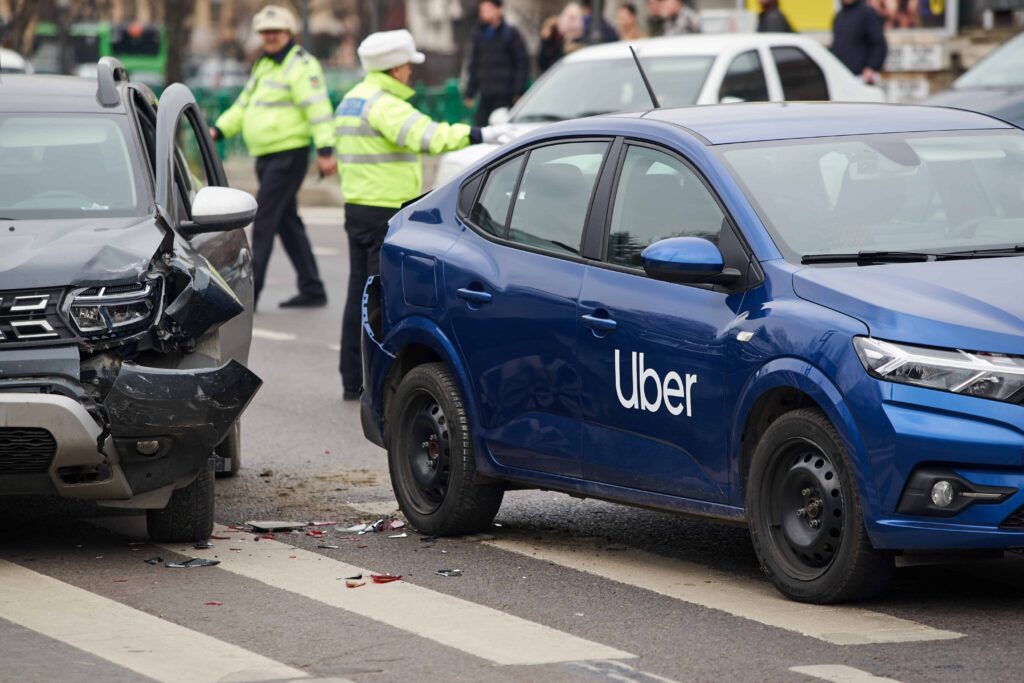
Because rideshare vehicles spend so much time in dense, urban areas, the accidents they are involved in produce a wide range of injuries. Even a low-speed collision can cause damage that leads to chronic pain and long-term medical needs.
Some of the most frequent injuries include:
- Whiplash and Neck Injuries: The sudden jarring motion of a collision can easily damage the soft tissues in the neck.
- Head and Brain Injuries: Striking your head on a window or seatback can cause anything from a mild concussion to a more severe traumatic brain injury (TBI).
- Back and Spinal Cord Injuries: A herniated disc or damage to the vertebrae can result in lasting pain and, in the most serious cases, paralysis.
- Broken Bones: The force of an impact commonly fractures wrists, arms, legs, and ribs.
- Internal Injuries: The blunt force of a crash can damage internal organs, an injury that may not be immediately apparent.
- Cuts and Lacerations: Shattered glass or torn metal may cause deep cuts that result in permanent scarring.
Where Do Rideshare Accidents Happen Most in San Diego?
Rideshare services are busiest in high-traffic areas, which naturally concentrates the risk of accidents in certain parts of the city. While a crash can happen anywhere, they frequently occur in locations with a high number of tourists, entertainment venues, and difficult intersections.
Common San Diego Accident Hotspots Include:
- Downtown and the Gaslamp Quarter: With its one-way streets, constant foot traffic, and packed nightlife, the Gaslamp Quarter is a frequent site of collisions, especially on weekend nights. Intersections along Broadway and Market Street are particularly challenging.
- Pacific Beach and Mission Beach: The combination of narrow streets, busy boardwalks, and a flood of visitors in areas like Garnet Avenue and Mission Boulevard creates a high-risk environment.
- Hillcrest and North Park: These energetic neighborhoods have busy commercial districts where intersections like University Avenue and 4th Avenue frequently see accidents.
- Major Freeways: Commuter traffic on I-5, I-8, I-805, and SR-163 means rideshare drivers are constantly navigating high-speed conditions where serious accidents can happen.
Many of these corridors are highlighted in San Diego's Vision Zero program as part of the city's "High Injury Network," the streets where the most severe and fatal crashes take place.
What to Do From Home After a Rideshare Accident
While your legal team manages the investigation and communicates with the insurance companies, there are steps you can take from home to protect both your health and your claim.
- Follow Your Doctor's Treatment Plan. Attend every follow-up appointment, physical therapy session, and specialist visit your doctor recommends. Insurance companies use any failure to follow medical advice as an argument that your injuries are not as serious as you claim.
- Keep a Pain Journal. Each day, write down your pain levels, physical limitations, and how the injuries affect your daily life. This journal becomes a powerful, real-time record of your suffering.
- Track All Your Expenses. Keep every bill, receipt, and statement connected to the accident. This includes medical co-pays, pharmacy receipts, and pay stubs showing your lost income.
- Get a Copy of the Police Report. The police report contains key details about the accident. We can get this for you, but it’s always good to have your own copy.
- Do Not Give a Recorded Statement. You are not obligated to give a recorded statement to the other party's insurance adjuster. They may use seemingly innocent questions to look for reasons to deny your claim. Let your attorney handle all communications for you.
- Stay Off Social Media. Insurance companies will look at your social media profiles. Posting photos or updates that appear to contradict your injury claims—even a simple picture of you out with friends—can be used against you. It is best to avoid posting until your case is resolved.
How Insurance Companies Approach Rideshare Claims

Rideshare companies and their insurance carriers are large corporations. As businesses, they must balance paying valid claims with protecting their profits.
An insurance adjuster may contact you soon after the accident and make a quick settlement offer. This offer almost always comes before the full scope of your injuries is known and typically fails to account for future medical care or lost income. As medical bills begin to pile up, it is easy to feel frustrated and pressured into accepting a low offer just to get some relief.
Our role is to manage this entire process for you so that your only focus is on recovery.
- We compile the evidence, document your losses, and present a comprehensive demand to the insurance company.
- We know their strategies because we have successfully negotiated thousands of cases against them.
This experience gives us the leverage needed to pursue the maximum value for your claim, hold them accountable, and ensure that any settlement offer fully covers your losses.
Get Clear Guidance for Your San Diego Rideshare Claim
It's easy to second-guess yourself, wondering if your injuries are "serious enough" or if calling a lawyer is an overreaction. That hesitation is normal, but it's not helpful. Getting advice is not a commitment to a lawsuit; it is a step toward clarity.
We can answer your questions, explain your options, and manage every detail of your claim while you focus on what truly matters: your health and your family.For a free, confidential consultation about your Uber or Lyft accident, call Harris Personal Injury Lawyers now at (619) 864-7101.